Skip to content
Part 2: PPE Gloves Selection – Scenario Guide, Mistakes to Avoid & Correct Usage
In Part 1, we covered PPE glove materials and PSC’s corresponding product recommendations. Now, we’ll dive into scenario-specific selection, common pitfalls, and correct usage – critical for maximizing protection. As a professional PPE solution provider, PSC is committed to helping you choose and use gloves effectively.
I. Scenario-Specific PPE Glove Selection (With PSC Solutions)
No single glove fits all scenarios. Below are tailored recommendations for 4 common scenarios, all supported by PSC’s mature product line.
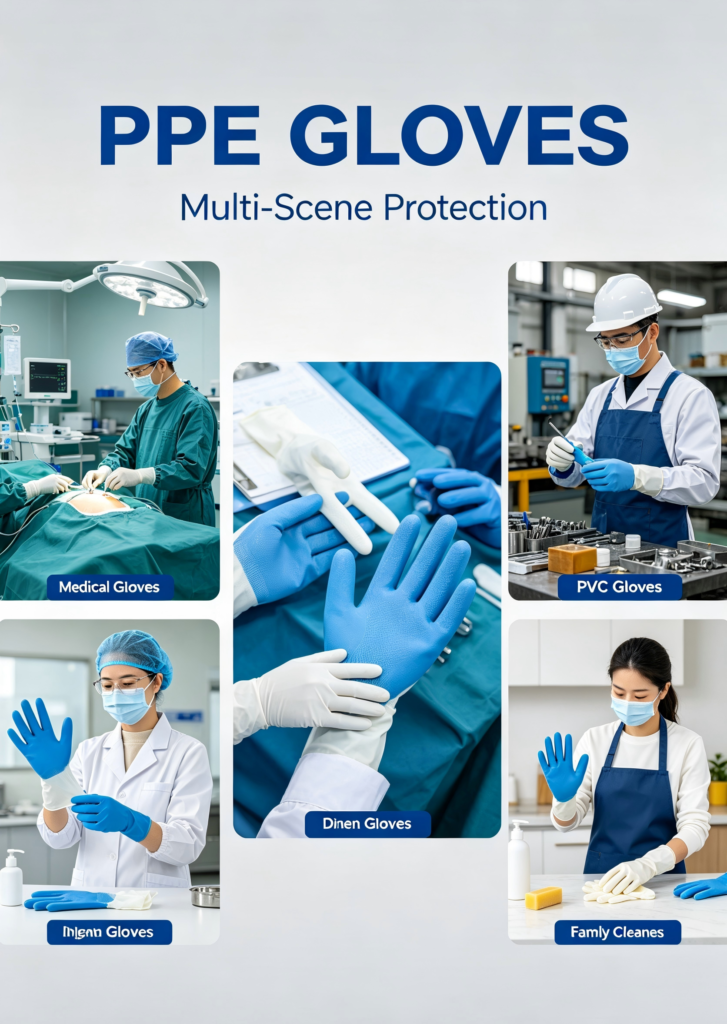
1. Laboratory/Chemical Scenarios
Core Risks: Chemical corrosion, reagent splashing, biological contamination. Key needs: Impermeability, flexibility.
Recommendation: Light nitrile gloves (0.1-0.3mm) for routine tasks; butyl rubber for strong acids/alkalis; PVA for dry aqueous tasks. Avoid latex. PSC’s laboratory gloves have enhanced impermeability and flexibility for precise operations.
2. Industrial/Construction Scenarios
Core Risks: Cutting, puncture, oil pollution. Key needs: Durability, wear resistance.
Recommendation: Leather/cloth gloves for cutting; neoprene/nitrile for oil tasks; Kevlar-lined gloves for puncture risks; PVC for basic protection. PSC’s industrial gloves have reinforced layers for harsh environments.
3. Medical/Nursing Scenarios
Core Risks: Biological contamination, disinfectant contact. Key needs: Sterility, no allergies.
Recommendation: Powder-free nitrile gloves (EN 455 certified); PVC for general nursing. Disposable only. PSC’s medical gloves are certified and sterile for staff and patient safety.
4. Daily/Light Protection Scenarios
Core Risks: Friction, stains. Key needs: Comfort, cost-effectiveness.
Recommendation: Latex (flexible) or PVC/nitrile (allergy-friendly) for housework; leather for gardening. PSC’s daily gloves balance comfort and value.
II. 3 Common Selection Mistakes to Avoid (PSC Reminder)
Mistake 1: “Thicker is Safer”
Thick gloves reduce flexibility and increase operational errors. PSC offers gloves of different thicknesses tailored to scenarios – light for precision, heavy for high-risk tasks.
Mistake 2: Ignoring Size
Ill-fitting gloves (too tight/loose) compromise protection. Leave 1cm fingertip margin. PSC provides a size chart and consultation to find your perfect fit.
Mistake 3: Reusing Disposable Gloves
Reused gloves lose protective ability and risk contamination. Dispose of disposable gloves after use. PSC emphasizes: correct usage is as important as correct selection.
Final Note
PPE gloves are your hands’ last safety line. With PSC’s high-quality products and professional guidance – from material to scenario selection, size to usage – you can avoid risks effectively.