Skip to content
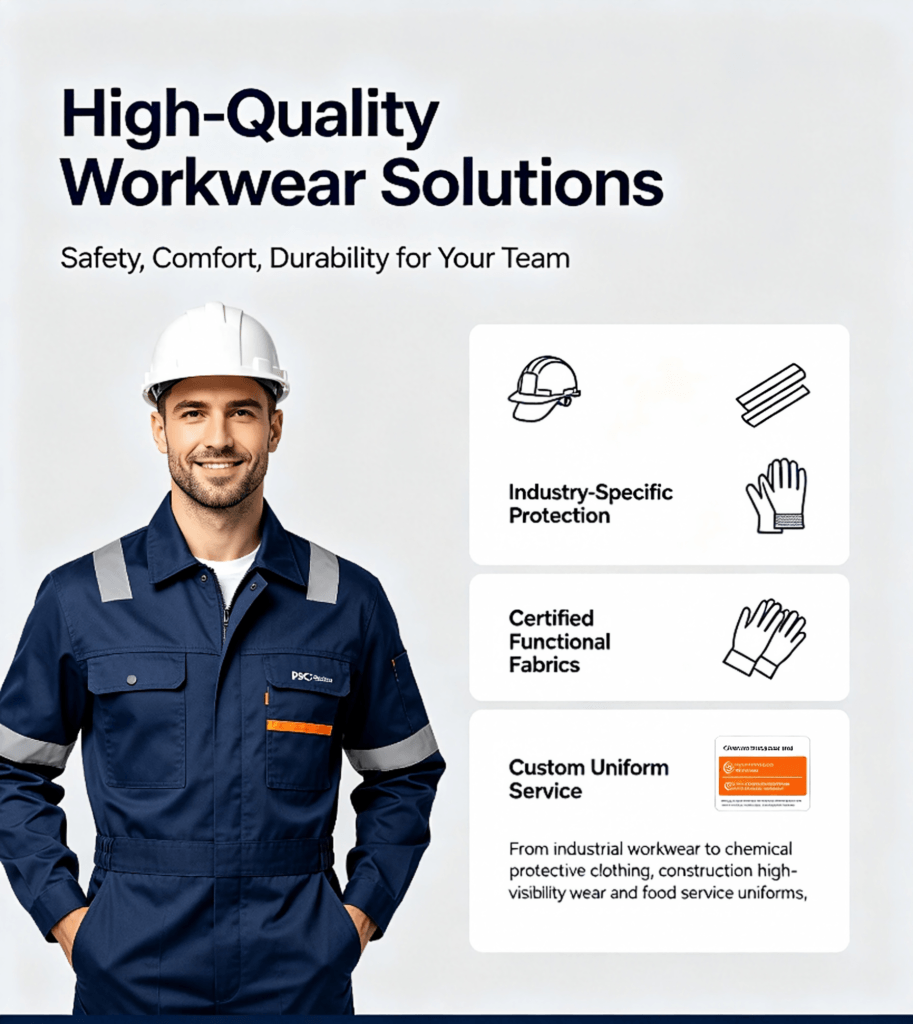
For any enterprise, professional workwear and safety work uniforms are far more than a simple staff uniform or brand display. It is the core protective equipment for frontline employees, a key barrier against workplace hazards, and an essential tool to ensure stable work efficiency and reduce operational risks. Properly selected workwear can effectively avoid common workplace injuries, improve employee comfort during long-hour work, and even standardize team management and enhance corporate professionalism.
Many businesses make the mistake of prioritizing low cost or appearance over practicality and safety when purchasing workwear. Improper workwear selection will not only restrict employees’ movements and reduce productivity but also easily trigger safety accidents and bring unnecessary losses to the enterprise.
This professional workwear selection guide will combineindustry-specific risk characteristics and high-quality product selection standards to help you pick the most suitable, durable, and safety-compliant workwear for different job scenarios.
1. Core Selection Principle: Safety First, Scenario Adaptation Second
The golden rule of workwear procurement: match functional protection with job risks first, then consider comfort, durability, and brand presentation. Different industries face completely different workplace hazards, so there is no one-size-fits-all workwear. Blindly universal procurement will lead to insufficient protection or functional redundancy.
Before purchasing, you need to sort out the core risks of the employee’s working environment: mechanical injury, high temperature scald, chemical corrosion, dust pollution, low-light traffic risk, static electricity hazard, etc. All fabric, style, and detail designs must serve risk prevention.
2. Industry-Specific Workwear Selection & Safety Matching Standards
2.1 Machinery Manufacturing & Hardware Processing Industry
Main Workplace Risks: Metal cutting scratches, iron filings scald, oil contamination, mechanical rolling entanglement, static electricity accumulation, and collision abrasion.
Professional Selection Standards
- Fabric: Choose thickened cotton or cotton-polyester wear-resistant canvas. Avoid thin pure chemical fiber fabrics at all costs—chemical fibers will melt and adhere to the skin when encountering high temperature, aggravating scald injuries. For spraying, painting and flammable and explosive posts, customize anti-static workwear to eliminate static hazards.
- Style Details: Adopt zipper design with shielding cloth, no exposed metal buttons to prevent equipment scratching and accidental hanging. Adjustable tight cuffs and trouser legs effectively prevent clothes from being involved in machine tools. Stand-up collar design blocks iron filings and dust from entering the collar. Add breathable sweat cloth on the back to solve stuffiness during long-time continuous work.
- Reinforced Design: Equip with reinforced multi-pockets with flap covers to prevent tools from falling and debris from accumulating. For heavy-duty machining posts, select workwear with double-layer patch reinforcement on elbows and knees for enhanced wear resistance.
2.2 Chemical, Electroplating & Laboratory Industry
Main Workplace Risks: Splash of acid-base corrosive liquid, organic solvent erosion, toxic dust adhesion, chemical burn.
Professional Selection Standards
- Fabric: Ordinary cotton and polyester workwear are not applicable. Select professional acid-base resistant and anti-corrosion functional fabrics, or PVC / nitrile coated barrier fabrics with excellent liquid barrier performance.
- Style Matching: Integral coveralls are the optimal choice for high-risk chemical posts, with fully sealed cuffs and trouser legs to achieve full-body isolation. For low-risk laboratory posts, high stand-up collar split workwear with elastic tightening is acceptable.
- Scenario Classification: Mild chemical contact scenarios adopt thickened acid-base resistant split suits; strong acid and alkali and dangerous chemical handling scenarios deploy reusable heavy-duty chemical protective clothing; dust purification laboratories equip with hooded integrated dust-proof and anti-static clean clothing.
2.3 Construction, Road & Outdoor Engineering Industry
Main Workplace Risks: High-altitude collision and scratch, gravel abrasion, sun exposure and rain erosion, low-light night construction traffic collision risk.
Professional Selection Standards
- Fabric: High-tenacity tear-resistant cotton-polyester blended fabric is preferred, with waterproof and sun-proof coating. Match seasonal designs: lightweight quick-drying breathable style for summer, detachable fleece-lined warm style for winter.
- Core Safety Configuration: Equip with high-brightness reflective strips around shoulders, waist and trouser legs, fully compliant with international high-visibility safety workwear standards, to improve recognition distance in dark, foggy and night working environments and avoid traffic accidents.
- Humanized Design: Loose version ensures flexible movement for climbing scaffolding and handling work. Large-capacity tool pockets meet the carrying needs of construction tools. Detachable inner liner realizes multi-season universal use and reduces enterprise procurement costs.
2.4 Catering, Food Processing & Service Industry
Main Workplace Risks: High-temperature scald, oil stain pollution, food hygiene contamination, frequent cleaning and wear.
Professional Selection Standards
- Fabric: Prioritize high-density pure cotton fabric above 200g, which is flame-retardant, high-temperature resistant, non-melting, safe and hygienic. Avoid chemical fiber fabrics to prevent secondary pollution to food.
- Style Requirements: Neat and concise version, dust-proof and easy to clean. Match breathable hats and mask reserved positions to meet food safety production specifications. Light-colored and clean color scheme is more in line with industry hygiene standards.
2.5 Office, Business & Light Service Industry
Main Demand: Professional image, comfortable daily wear, breathable and skin-friendly, neat and unified.
Selection Standards: Select soft and breathable cotton-polyester blended or fine cotton fabrics, with slim and neat version. Focus on wrinkle resistance and easy-care performance to ensure long-term neat appearance, suitable for front desk, administration, customer service and other posts.
3. High-Quality Workwear Identification & Purchasing Guide (Avoid Low-Quality Products)
Many enterprises encounter problems such as fabric fading, thread cracking, poor functionality and short service life after purchasing workwear. To select cost-effective and durable high-quality workwear, you can refer to the following 4 core evaluation dimensions:
3.1 Check Fabric Quality & Functional Compliance
Fabric is the foundation of workwear quality. High-quality workwear fabrics have uniform texture, tight weaving, no peculiar smell, good air permeability and wear resistance. Special functional workwear must provide professional test reports:
- Anti-static, flame-retardant, acid-base resistant workwear: verify functional certification to ensure that the protection performance meets industry standards;
- Daily wear workwear: check fabric gram weight and component ratio, avoid thin and inferior fabrics that are easy to pilling and fading;
- Outdoor high-visibility workwear: confirm the reflectivity and durability of reflective strips to ensure no failure after repeated washing.
3.2 Check Fine Workmanship & Structural Stability
Durable workwear depends on details. High-quality products have neat and dense stitching, no loose threads or skipped stitches. Key stress parts such as shoulder joints, pocket edges and cuffs are reinforced with double stitching to prevent cracking during work. The zipper slides smoothly without jamming, and the buttons are firm and not easy to fall off.
3.3 Verify Comfort & Operational Adaptability
Excellent workwear balances safety and comfort. Too tight clothes restrict movement and reduce work efficiency; too loose clothes have potential safety hazards of hanging and entanglement. High-quality customized workwear adopts ergonomic design, with reasonable version reserve, flexible movement, long-term wear without stuffiness and fatigue, effectively improving employee work experience and efficiency.
3.4 Evaluate Customization & After-Sales Service
Reliable workwear suppliers support personalized customization such as enterprise logo printing, color matching and size adjustment, which helps shape a unified professional team image. At the same time, perfect after-sales service such as size replacement, quality problem return and exchange, and batch order delivery guarantee is an important guarantee for enterprise bulk procurement.
4. Common Workwear Purchasing Mistakes to Avoid
- Only focus on low price: Low-cost inferior workwear has unqualified protection performance and easy damage, increasing enterprise safety risks and replacement costs in the long run;
- Universal uniform procurement: Different posts have different risk points. Universal workwear leads to insufficient protection for special posts and wasted functions for ordinary posts;
- Ignore seasonal adaptability: Thick winter clothes in summer cause stuffiness and heatstroke, and thin summer clothes in winter fail to keep warm, affecting employee work status;
- Neglect detail safety: Exposed metal parts, loose trouser legs and unprotected zippers are easy to trigger mechanical accidents.
If you would like detailed information about various types of workwear, feel free to contact PSC (Passion Safety Limited China) at any time; we are ready to provide professional advice, quality products, and accurate price quotes.